Propellor-driven Bicycles
|
| |
Gallery opened: 1 Dec 2018
Updated: 23 Mar 2026
New prop-cycle added here.
 
| |
This gallery deals with propellor-driven cycles where the propellor is turned by pedal-power. Motor-driven propellor bikes are in this gallery.
It is explained on the propellor-driven car page that a propellor is very inefficient at low speeds. This did not (if they knew it) deter the constructors of propellor-driven motorcycles. The impracticability is even greater in a machine where the only power source is human effort, and this probably explains why propellor-driven bicycles are rather rare compared with propellor-driven motorcycles.

 |
| Left: British propbike: date unknown
It is of course perfectly possible to attain 15mph on an ordinary bike- in fact it would almost certainly be much easier, without the extra friction of the propellor drive and the propellor losses.
|
 |
| Left: Unknown propbike: date and location unknown
This superb picture shows a prop-bike with a rather complicated drive system for the propellor. The pedals drive the two wheels up in the air by a chain, and these wheels drive the propellor via two chains, or possibly toothed belts. There must be some sort of right-angle gearing inside the triangular fairing just behind the propellor.
There is no drive to the rear wheel.
It all looks rather heavy. Why a double drive to the propellor was considered necessary is mysterious.
Note the odd double road wheels; possibly they were needed to support the extra weight.
Unfortunately a Google image search yielded no more info.
|
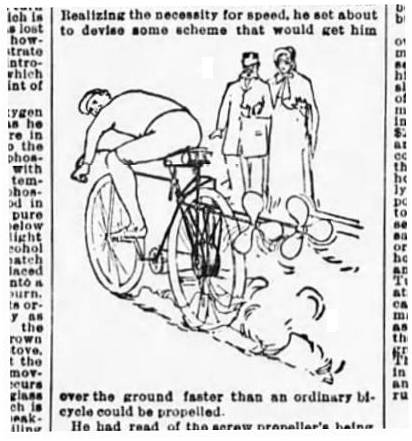 |
| Left: Twin-propellor propbike: New Jersey USA, 1893
This is the first prop-bike found with twin propellors. It was built by Frederick Heller of Caldwell, New Jersey, who was a “prominent cyclist” and a plumber by trade. The Sun article says: “The propellers used are made of brass and are similar to those used as electric fans,” adding that Heller “has only recently perfected his invention, but he says that within the past week he has beaten most of the local riders and some pretty good horses. He has made an application for a patent on his schemes and says he would not sell it for big money.”
I find it hard to believe that this contraption could outrun a pretty good horse.
The drawing shows two propellors that look more like ship propellors than those used on aeroplanes; they were driven by belts from pulleys on the rear wheel, which is clearly providing some at least of the forward thrust. It's a poor drawing as the propellors look as though they might hit each other.
Source: 29 October 1893 edition of The Sun, New York.
|
 | 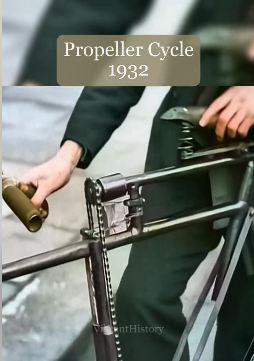 | 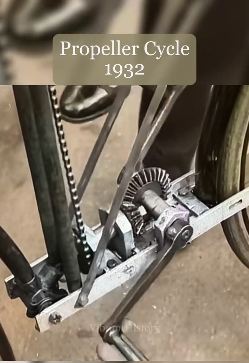 |
| Left: Propbike: 1932
Nothing is known about this machine apart from the date. The pedals drive a bevel gear that turns a short fore-and-aft shaft which drives by chain the horizontal propellor shaft; really quite neatly done.
You can see a video of the bike in action here; the stills were taken from it.
|
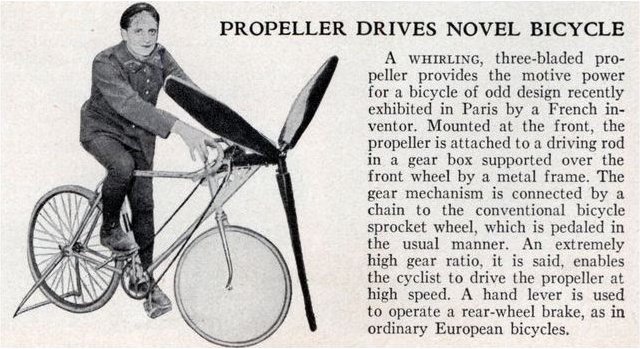 |
| Left: French prop-cycle: 1936
Given the light weight of the bicycle, there may have been some interesting gyroscopic effects when turning corners.
The propellor is chain driven from pedals in the usual place, and geared up to rotate faster. Presumably there was bevel gearing to turn the drive through a right-angle.
We now have a three-bladed propellor.
From Popular Science Nov 1936
|
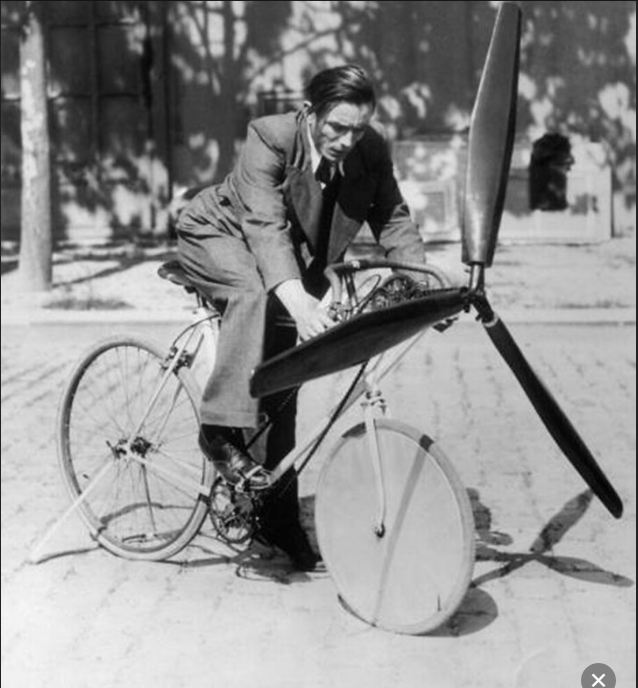 |
| Left: French prop-cycle: 1936
This is clearly the same machine, but the rider is now rather less confident, and looks as if he might be regretting the whole business.
It can be seen here that the front wheel is solid- possibly to accommodate the extra weight of the propellor.
The French inventor presented it at a exhibition in Paris.
|
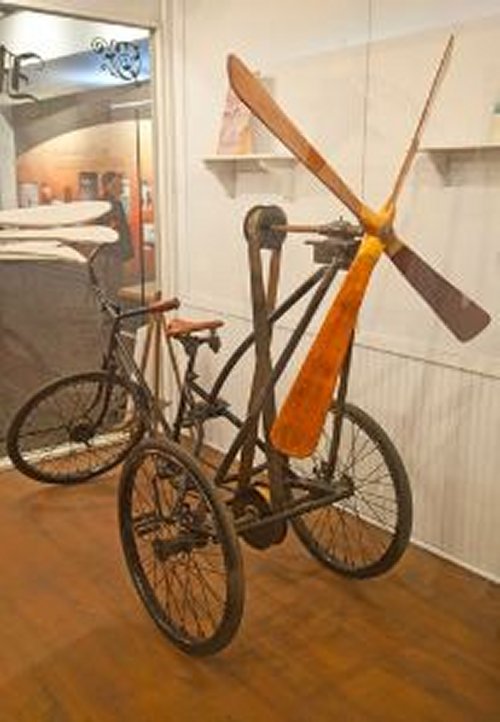 |
| Left: French (?) proptrike: 1920?
This proptrike drives the pusher propellor by means of a twisted belt from the rear axle. From the pulley sizes it looks as though the propellor rotates at about twice the speed of the rear axle.
A Google reverse-image search yielded nothing.
This appears to be in a museum, location unknown. Photograph dated 2012.
|
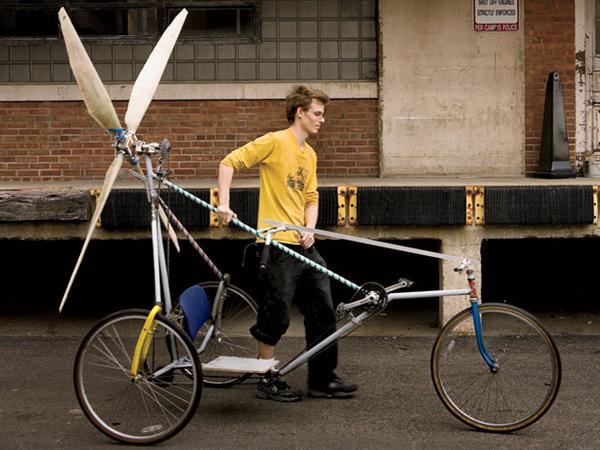 |
| Left: The MIT propellor tricycle: 2007.
As noted above, prop-bicycles are rather rare, so in the spirit of inclusion here is a prop-tricycle. This recumbent trike was built by Damon Vander Lind and some fellow MIT students. It is built from high tech aircraft-style chromoly tubing and salvaged bicycle parts.
The propellor is driven by belt and pulleys that appear to give a speed increase of about two times; it is 7 feet in diameter. We now have a four-bladed propellor.
The tricycle was built in 2007.
|
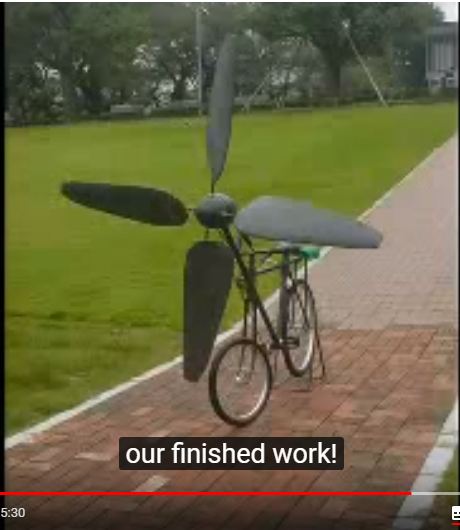 |
| Left: The Kiki's Delivery Service variprop bike realised: 2010
This propbike is derived from an anime cartoon called 'Kiki's Delivery Service'. A character in it called Tombo rides a propbike, and some guys in Japan have made a very good job of turning it into reality. This included varying the airfoil section along the propellor blades. See the YouTube video; at the end you can see the propbike bowling along the road carrying two people. That is actually Part 2; Part 1, dealing with details of frame construction is also on
YouTube.
There is a third video of the propbike in action on YouTube, but the video quality is dire. This machine deserves better.
'Variprop' because the propellor has variable pitch, (which I assume translates into greater efficiency) and it appears that this can be altered via a Bowden cable while the bike is moving; I am impressed. Drive is by chain up to the egg-shaped nacelle, which contains a bevel gear to turn the drive through a right-angle.
|
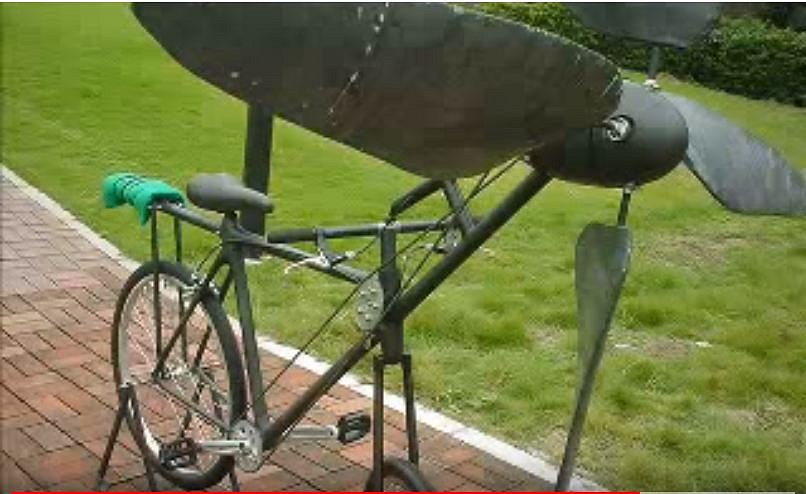 |
| Left: The Kiki's Delivery Service variprop bike realised: 2010
This shows the drive system. It is a faithful copy of the picture below, including the absence of drive to the rear wheel.
|
 |
| Left: The Kiki's Delivery Service variprop bike in flight: 2010
The original Kiki's Delivery Service propbike. Unlike the real recreation, it can apparently fly quite easily with just one human pedalling, which is impressive considering it doesn't even have any wings.
But... it is worth pointing out that the young lady on the back is quite capable of taking off on just a broomstick (the black cat gives a hint) and there may be more at work here than just aerodynamics.
|
